|
|
New Stock Listing
This page lists any stock that has been added in the last 60 days, together with any  "Featured" items in stock. "Featured" items in stock.
Click any of the headings to see the current stock page for that category.
| Reference |
Stock Item |
|
Description |
Price |
|
|
 |
 |
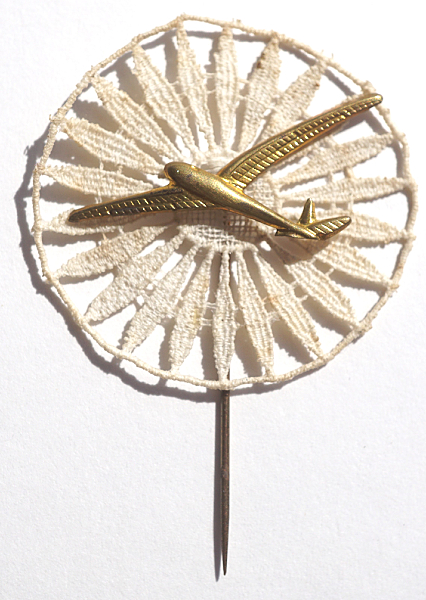
New Stock - 16 days agoNSFK Göppingen Gö 3 Minimoa Sweetheart Badge - A rare, private-purchase German Nationalsozialistisches Fliegerkorps (NSFK) glider lapel pin badge. While British and Allied forces commonly produced official and custom "sweetheart" brooches for loved ones to wear on civilian clothing during WWII, Nazi paramilitary organizations like the NSFK did not issue traditional "sweetheart" variants. This example is the first we have seen in over 20 years of trading and was sourced as photographed from France. It came complete with a paper backer on which is finely written in French : "Souvenir de Guerre Allemande 1939-1945" which literally translates to "German War Souvenir 1939-1945" or "German War Memento 1939-1945". We can only presume this little badge was found in France during or after the occupation and at some stage crossed the English Channel or as the French call it "La Manche".
The NSFK was formed on 15th April 1937 as a successor to the German Air Sports Association; the former had been active during the years when a German air force was forbidden by the Treaty of Versailles. The primary functions of the NSFK were to organise the pre-military training of civilians destined for the Luftwaffe, in particular the members of the flying section of the Hitler Youth, and to continue to promote airmindedness among the civilian population and enabled fixed wing training though gliding. The glider featured on our pin is a Göppingen Gö 3 Minimoa, of which 110 were built by the manufacturer Sportflugzeugbau Schempp-Hirth between 1935 and 1939. This was a high-performance sailplane, instantly recognised by its swept back gull-wing configuration, with a thick wing root which gradually thinned down to a symmetrical profile at the tips, to prevent aerodynamic stalls, as illustrated in the period photographs attached in our listing.
The miniature glider is mounted in front of a finely embroidered fabric roundel, with the glider wingspan just 1.4" (3.5 cm) and the fabric roundel measures 1.5" (4 cm). Small, but beautifully formed, this is a rare survivor and would make a significant addition to an NSFK collection or a more general gliding display. Almost certainly a one off that seems unlikely to ever be repeated.
|
£65.00
|
|
|
 |
|
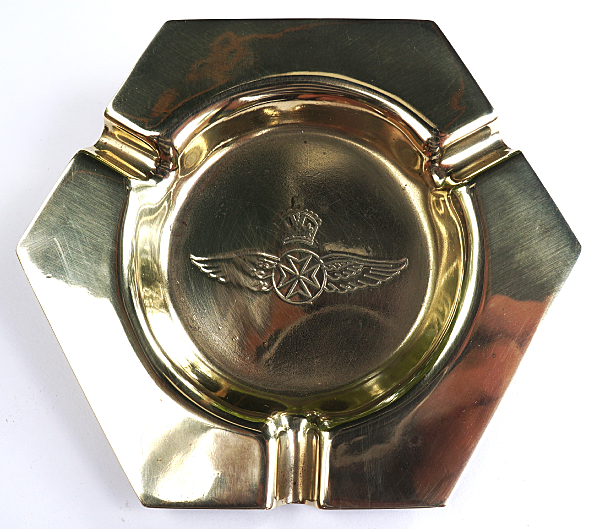
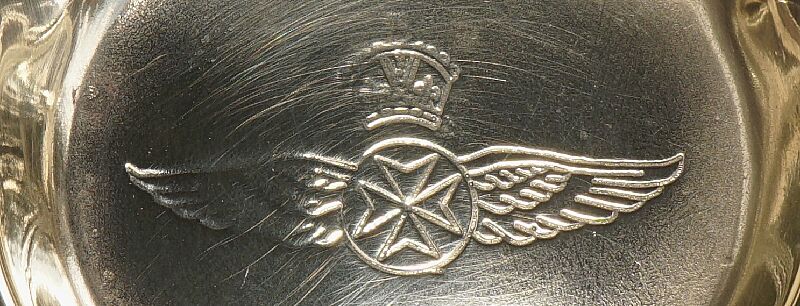
New Stock - 16 days agoMaltese Trench Art Ashtray - This one is a bit of a conundrum! The ashtray is pressed from a solid piece of brass and looks to be hand made, as opposed to a commercially produced item, so is more than likely a piece of WWII trench art. It features a pair of engraved aviation wings, with a Kings Crown above and to the centre a Maltese Cross.
Extensive online research has failed to find an exact match, but the closest we have come is that this could possibly relate to 22 Squadron of the RAF. When the badge was approved by King Edward VIII in 1936, the squadron were supporting the British response to the Abyssinia crisis from Malta, hence the inclusion of the Maltese Cross. Further research however indicates RAF 126, 185 and 261 squadron badges also incorporate a Maltese Cross, so the debate remains wide open. The other alternative is it relates to the Air Wing of Malta's Armed Forces, but as this was only created in 1973 and we feel sure this ashtray predates this, so we have ruled this option out.
Our current conclusion is it was manufactured on Malta in WWII as a generic souvenir by or for RAF personnel serving on Malta to take home to friends and family. If any visitors to our site can add anything more definitive to our speculation please get in touch. Condition remains excellent, with the top surfaces finished in polished brass, whilst the underside has been left "Au naturel". It is in hexagonal form with each of the six sides measuring 2. 5" (6 cm)
|
£28.00
|
|
|
 |
|
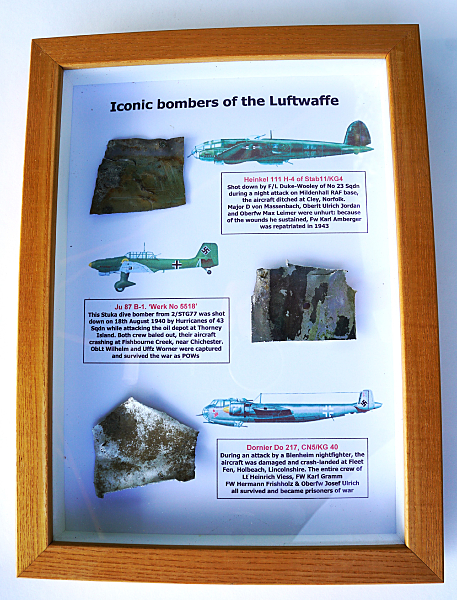
New Stock - 3rd August 2026Iconic Bombers of the Luftwaffe Framed and Mounted crash Relics - On offer is a professionally mounted box framed selection of 3 fragments of relic skin recovered from WWII Luftwaffe aircraft crashes. The first is from a Heinkel 111 coded H-4 of Stab 11/KG4 that came down in shallow water off Cley Next to Sea, Norfolk during the Battle of Britain on 19th June 1940. The remains of the wreck remained in situ off the Norfolk coast but was considered to present a hazard to navigation and was sadly blown up in 1969 on the order of Trinity House. Looking at the images of the wreck, it is so close to the shore it hardly looks like it was any 'hazard to shipping' but the decision was taken by some unnamed bureaucrat and the airframe remains were lost to prosperity. (Relating crash photographs are shown in our listing)
The second relic is from Junkers Ju 87 B-1 Stuka Werk nos 5518 and code A5+DN that was also shot down during the Battle of Britain and crashed on August 18, 1940. Coincidentally this date is called "The Hardest Day" or the "Massacre of the Stukas, " which resulted in the withdrawal of Ju 87 units from the Battle. The aircraft broke up in mid-air and crashed into Fishbourne Creek, near Chichester. Both crews baled out and were captured.
The third and final incident relates to a Dornier DO217 coded F8+CN of CN5/KG40 that crashed at Fleet Fen, Holbeach, on 23.10.42. The crew baled out and were all captured as POWs.
Each crash relic features some original paint and has been nicely mounted bedside line drawings of representative relating aircraft
|
£35.00
|
|
|
 |
|
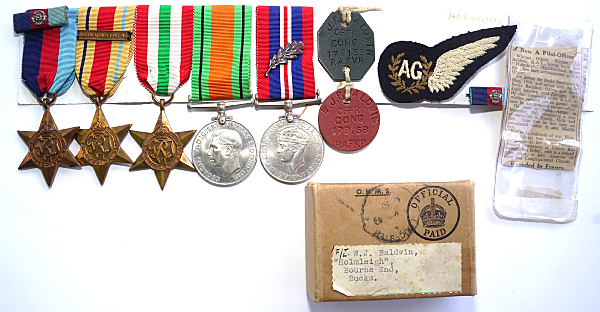
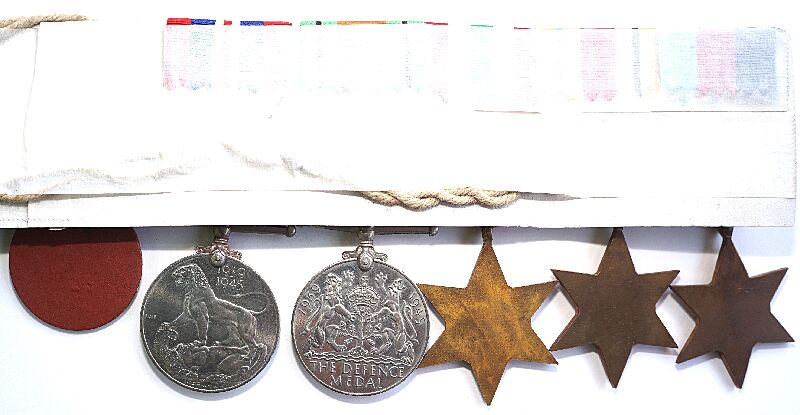
New Stock - 28th July 2026Medal Grouping to F/Lt W. J. P. Baldwin RAFVR - On offer is a scarce fully attributed WWII medal grouping, dog tags and Air Gunners brevet, named to Flight Lieutenant William John Pel Baldwin. Whilst this officer's service history remains largely unresearched, it fortunately includes a period (undated) newspaper clipping that gives a synopsis of William Baldwin's WWII career. He initially joined the Bucks Territorials in May 1939 and served with the 2nd Bucks Battalion, Oxford and Bucks Light infantry, until February 1941 when he transferred to the RAF. He trained as a Wireless Operator/Air Gunner and was promoted to Warrant Officer. Posted to North Africa in November 1942 he completed a full tour serving in Tunisia, Sicily and Italy. Following the successful conclusion of his tour he was posted to a training role. We have also established Balwin survived the war (unlike c.55,000 of his colleagues in Bomber Command) and was awarded a Mention in Despatches in the Kings New Year Honours of 1946, when he was listed as a Flight Lieutenant.
Baldwin's medal grouping, which is in fine condition and unnamed as issued, is made up of a 1939-45 Star with Clasp, awarded to the aircrew of Bomber Command who served for at least sixty days, or completed a tour of operations, on a Bomber Command operational unit and who flew at least one operational sortie. The award of the Clasp is denoted by a silver rose Emblem when the ribbon alone is worn, one pin back example is included. Next, we have his North Africa Star with 1942–43 Clasp, awarded for service with the Royal Air Force in specified areas from 23rd October 1942 to 12th May 1943 inclusive. This is followed by the Italy Star, the Defence Medal and the 1939-1945 War Medal with the Mention in Despatches Oak Leaf attached, awarded as detailed above.
In addition to his medal grouping, we also have both his fibre Dog Tags, named to W. J. P. Baldwin, 'OFFR' (Officer) and 'CONG ' (religion Congregationalist).According to the newspaper clipping Baldwin's father, a retired Police Officer was the Hon Secretary of the Cores End congregational Church. The dog tags also detail F/Lt Baldwin's Officer's service number 179158. Finally, we have the original Air Ministry box that contained Baldwin's medal and addressed to him at his (or his parents?) residence "Holmleigh", Bourne End, Bucks, as final picture attached (by courtesy of Rightmove! which shows his home as it is today. Whilst the despatch date is not entirely clear this seems to read March '49
A very good grouping that warrants further research. If any visitors to the site can add details of Baldwin's squadron, aircraft flown and Ops flown we would be happy to update our listing but believe we have sufficient details already for further detective work. With additional research the group deserves to be mounted and display framed.
|
£225.00
|
|
|
 |
|
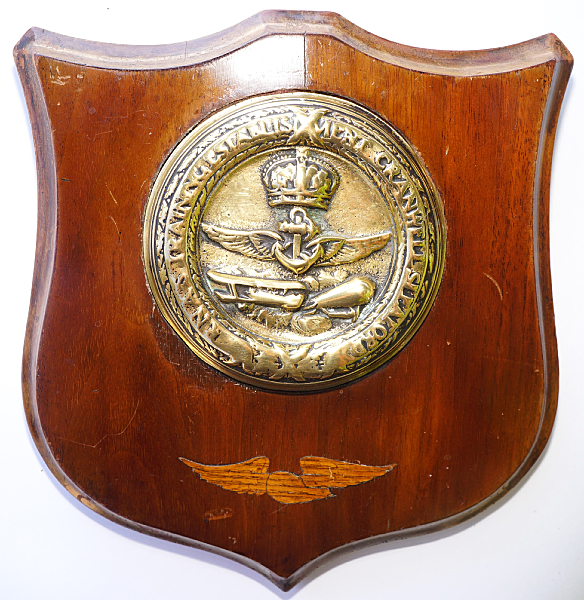
New Stock - 28th July 2026RNAS Training Establishment Cranwell Plaque - A very scarce and possibly unique Royal Naval Air Service mahogany shield with an attached King George V period brass badge attached and below an inset marquetry RNAS eagle. The brass badge features in relief an outer surround consisting of a raised laurel band with a scroll within, a Kings crown above a set of wings which feature a fouled anchor to the centre and beneath images of a biplane and dirigible. The circular border carries within the legend 'R. N.A. S. Training Establishment Cranwell Sleaford '.
Whist Cranwell is normally associated with the RAF, the history of military aviation at Cranwell actually goes back to November 1915, when the Lord Commissioners of the Admiralty decided that the Air Department should centralise its pilot, airship crew and balloonist training programmes at a single establishment. The Admiralty duly requisitioned 2,500 acres of land from the Marquess of Bristol's estate and the "Royal Naval Air Service Training Establishment, Cranwell" was born. Officially opened 1 April 1916 and like all naval shore stations, had an 'HMS' prefix, Cranwell being named HMS Daedalus. The site was used by the Navy for training of all types of aviation from kite balloons, airships through to fixed wing aircraft. The Navy's tenure at RNAS Cranwell was however short lived as on 1st April 1918 the RNAS and the RFC were combined to form the RAF. On this date, with the establishment of the Royal Air Force as an independent service, the RNAS Training Establishment Cranwell became RAF Cranwell with the Royal Air Force College Cranwell being created on 1 November 1919.
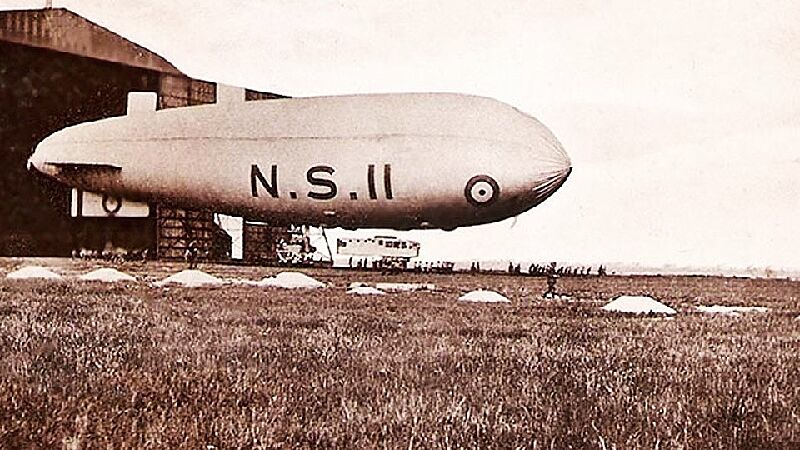
The first historical photographs shown is of King George V & Queen Mary taken in 1918 on a visit to Cranwell. Walking with the Queen is her son HRH Prince Albert Victor (later George VI). He was appointed to Cranwell in February 1918 as Officer in Charge of young ratings and then became Officer Commanding No.4 Squadron of the Boys' Wing under the RAF, when it formed in April. He left Cranwell in August 1918. The final photograph attached shows a North Sea class airship number 11 leaving its shed at RNAS Cranwell. In the early hours of 15 July 1919, on a flight over the North Sea, NS11 exploded and was lost with all hands, crashing off the coast of Norfolk, near Blakney Point.
As can be seen RNAS Cranwell was only in existence for just 2 years, making this plaque a very scarce or possibly unique survivor. We do know the National Museum of Scotland has an aluminium badge of the same type in its collection but otherwise in a lifetime of collecting we have never seen another. We have speculated the brass plaque may have started life as a ceremonial 5" gun tompion used at RNAS Cranwell and subsequently mounted for display after the establishment of the RAF. If any visitors to the site can add any further information we would be delighted to hear from you, but in the meantime we challenge you to find another.
The shield is in generally good display condition but now showing the expected signs of age wear, hardly surprising seeing it must be at least 108 years old! Likewise, the brass plaque remains sound, although the RNAS Cranwell casting is a little feint, caused no doubt by years of polishing over the passing years. We would imagine this is a one-off opportunity to add a piece of history to your RNAS, Naval or RAF collection. The shield measures 10.5 "X 9.5" (26 cm x 24 cm) and the plaque 5" diameter (12.5 cm)
|
£250.00
|
| Reference |
Stock Item |
|
Description |
Price |
|
|
 |
|
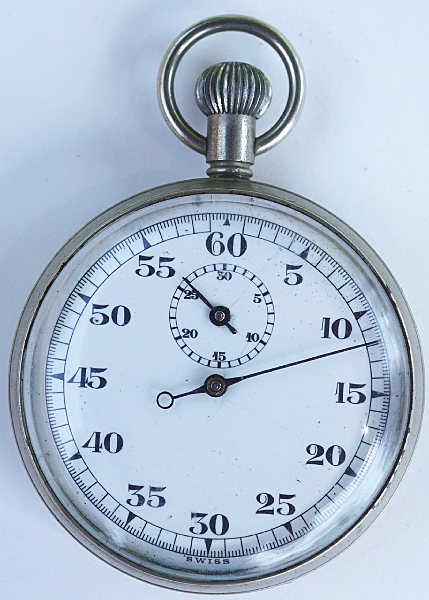
New Stock - 3rd August 2026RAF Aircrew Mk III stopwatch 6B/117 - A very clean example of a Mk III aircrew stopwatch crisply engraved to the rear of the case with a George VI Kings Crown, Air Ministry property mark 'A. M. ' and stores reference 6B/117. The '6B' category covers equipment used for air navigation, including compasses, sextants, stopwatches, computers, and pilot watches. The stores reference 6B/117 indicates a Navigator's or Bomb Aimers Stopwatch Mk III. These precise mechanical pocket stopwatches were standard issue for aircraft navigation and for bomb timing prewar and during WWII. The case is also marked 673-38, confirming this was the 673rd example issued under that specific contract in the year 1938. Being of prewar manufacture the quality or the case markings is far superior to later examples, thus making this watch rather more desirable to collectors.
The case measures approximately 2" diameter (5 cm) and whilst the movement is not maker marked it is of Swiss manufacture and is mounted in a white metal case, with white dial and black hands featuring a 60 second main dial and 60 minute subsidiary. The watch has standard crown winding and was designed for an 8-hour duration when fully wound and the chronograph action is controlled by the winding knob. The watch was designed so that the second hand should indicate accuracy to one-fifth of a second, and that starting and stopping errors should not exceed one-fifth of a second. The case and dial remain in excellent issued condition and the only minor issue noted is a very small hairline crack to the enamel dial at the 1230 position but is hardly noticeable. Whilst we have not had the movement serviced all is currently working as intended but we can't guarantee its accuracy and is thus for sale as an historic collectable.
Finally, we were told when purchased this watch was issued to and used by a G. C. Taverner RAFVR in WWII. We have nothing to support this but online research indicates a match with a Geoffrey Clifford Taverner 175675 served with the RAF in WWII and was promoted to Sgt on 29 August 1944. He was assigned to 51 Squadron and flew as a navigator and bomb Aimer on Halifax aircraft and successfully completed an amazing 41 operations and survived the war. He was awarded a DFC in recognition of his service on 25.09.45 and was also appointed Chevalier De La Legion D'honneur. The suggested provenance, if correctly researched, adds significantly to the interest of this piece, but we stress is based entirely on limited word of mouth facts when purchased.
Final scans attached are from my friend Konrad Knirim's definitive reference 'bible' 'British Military Timepieces'.
|
£145.00
|
| Reference |
Stock Item |
|
Description |
Price |
|
|
 |
|
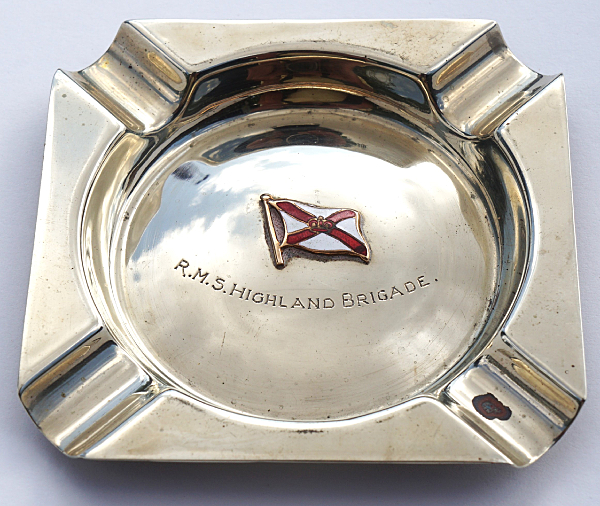
New Stock - 17 days agoR. M. S. Highland Brigade Troopship Ashtray - The RMS Highland Brigade was a 14,131 gross register ton passenger and cargo liner built in 1928 by Harland and Wolff in Belfast. She initially served the Nelson Line before being transferred to Royal Mail Lines in 1932, operating primarily on the London to River Plate route.
During World War II, she was requisitioned as a troopship, operating across the Mediterranean, Middle East, and Asia, and in late 1945 helped repatriating Australian and British former prisoners of war from Singapore. On January 18, 1946, she struck a sea mine and was in danger of sinking but was towed to Singapore with no loss of life. The final photograph attached shows her under tow towards the safety of Singapore, courtesy of the Imperial War Museum archive. In 1947 she resumed on the South America service until sold to John Latsis of Piraeus in 1959 and renamed "Henriett". She was then renamed again the following year "Marianna"and was employed as a Mecca Pilgrimage ship, before being scrapped at Kaohsiung, Taiwan in 1965.
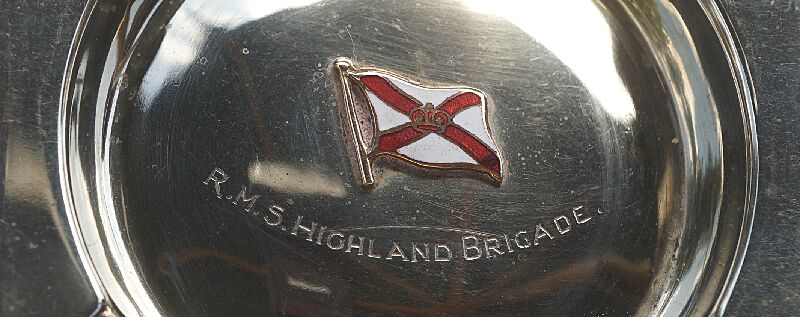
The souvenir ashtray carries a brass and enamel house flag of the Royal Mail Steam Packet Co. London, comprising a white flag with a red saltire overall and to the centre a Crown and below is engraved 'R. M. S. Highland Brigade'. The reverse is marked Made in England and EPNS. The plating is generally in very good conation with just one area of wear on the cigarettes recess at the 4 o'clock position. The ashtray measured 3" x 3" (7.5 cm x 7.5 cm) This is the first item we have ever had an item relating to Highland Brigade in over 20 years of trading, so quite a rare survivor.
|
£30.00
|
|
 |
 |